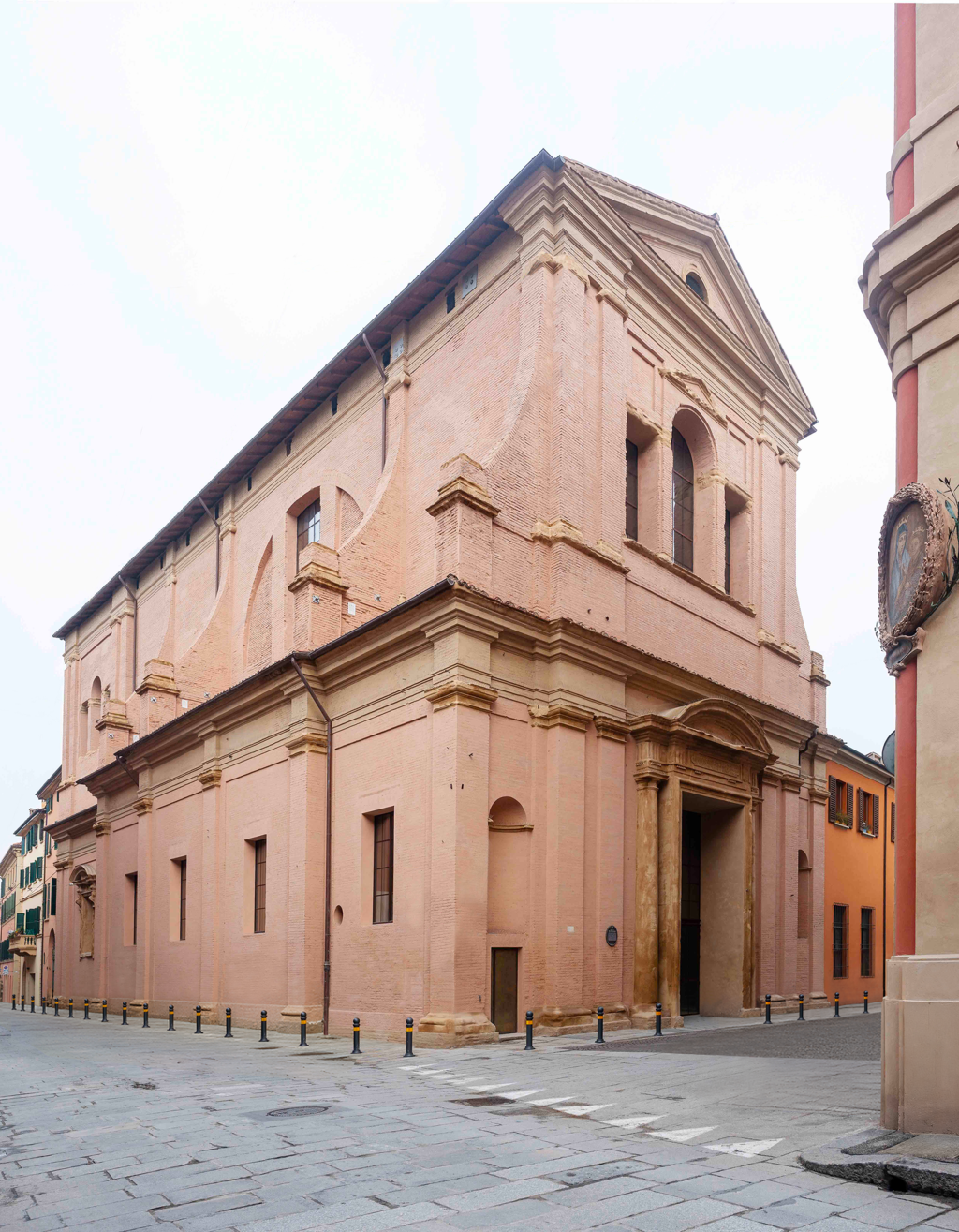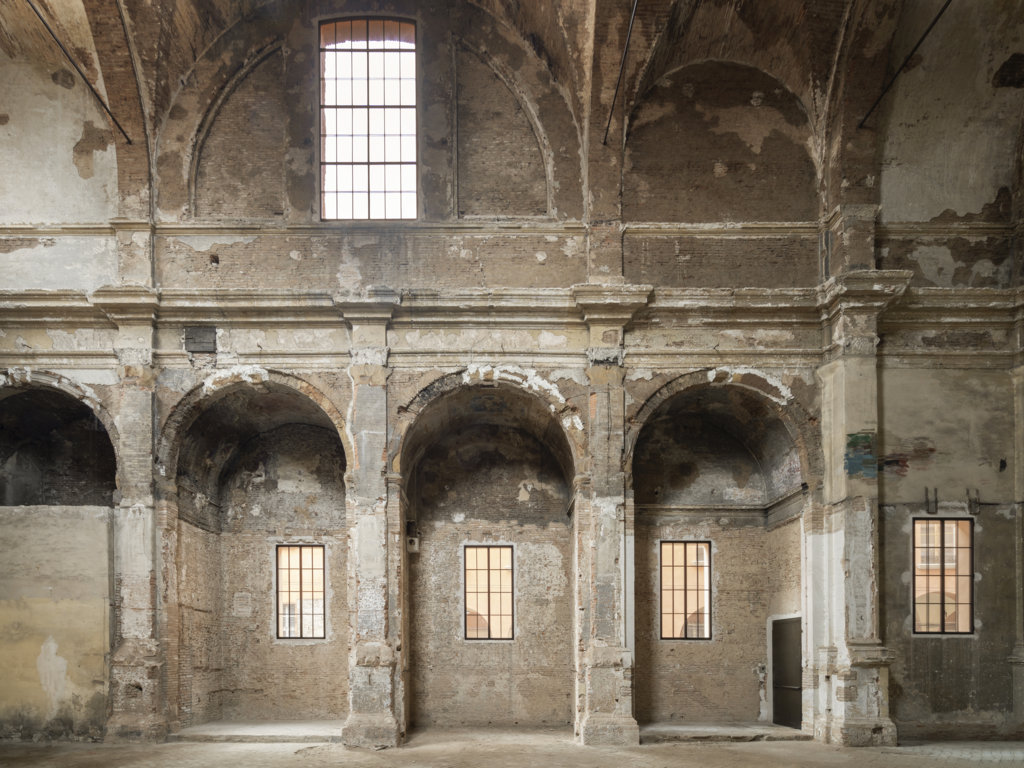

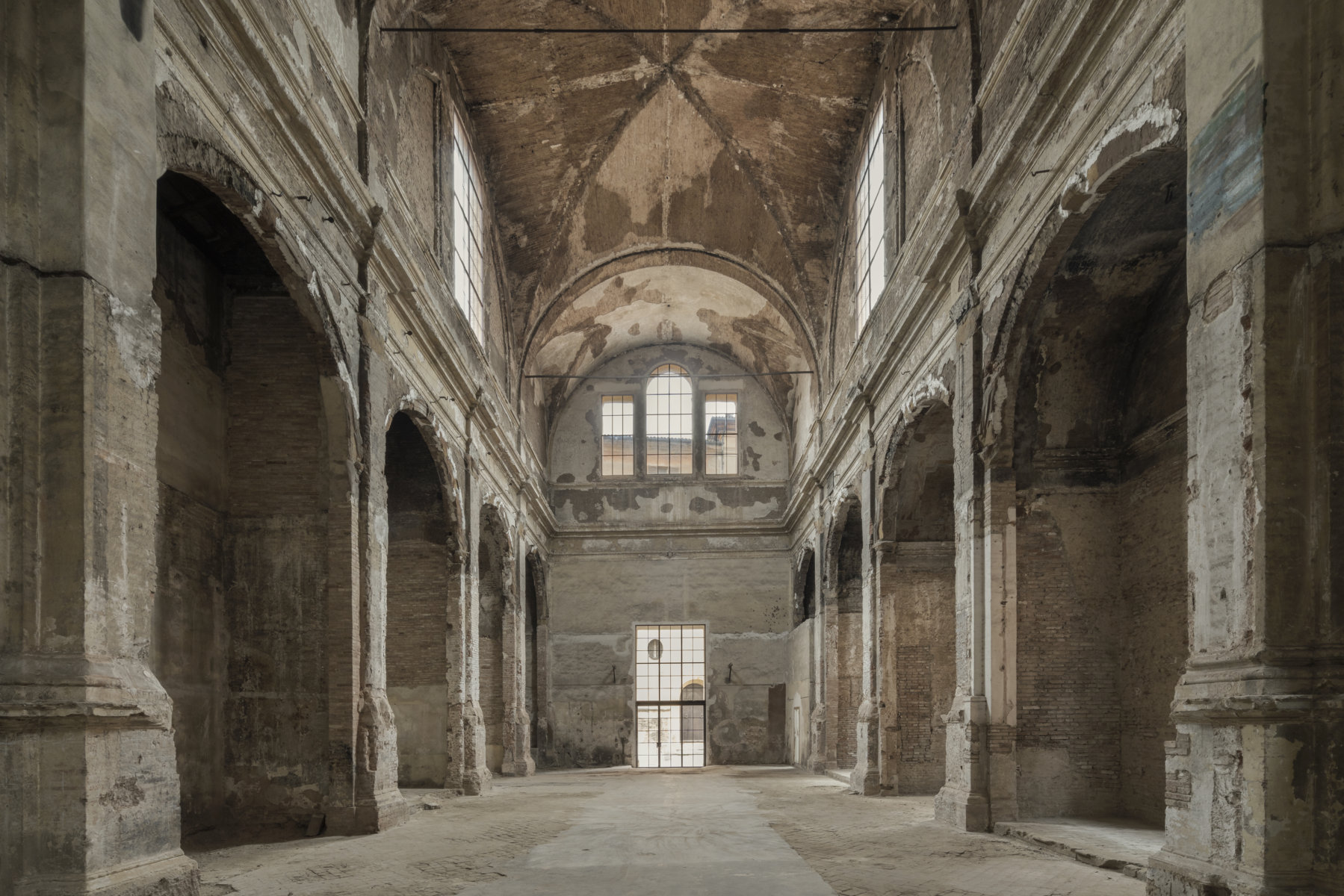
The former Church of San Barbaziano, a little treasure in the historic center of Bologna, has had a very turbulent history. For years mistaken for something far more ordinary, it has served multiple uses, recently even transformed into a garage, yet the beauty that distinguishes both the architecture, and its stratification makes it uniquely special. Not simply a building, but a record of uses, misuses, and intervals of neglect. Now, after decades of quiet disintegration, it has been returned to the city in a state that preserves both its rawness and in its peculiar history.
The project, completed in 2025 by the Bologna-based Studio Poggioli, led by Federico and Caterina Poggioli, does not so much restore the church, but rather recalibrate its relationship with time. The architects have described their approach as a “progetto del tempo,” and the definition feels exactly as a working method: an attempt to allow the building’s past to remain visible without conforming to the aesthetic coherence that restoration often demands.
San Barbaziano’s biography, unusually dense, even by Italian standards, traces his origins, a claim contested by contradictory historical testimonies, back to the early Christian era. Designed in 1608 by the architect Pietro Fiorini as a late-Mannerist, single-nave church with four pairs of side chapels, it has undergone centuries of incremental transformations: a monastic site, then a Napoleonic casualty, then a hayloft, a military warehouse, a mechanical workshop. A fire in 1922 compromised what remained of its decorative program; the decades that followed did not so much destroy the building as repurpose it into anonymity. By the late twentieth century, it functioned as a garage, its sacred volume flattened into utility, its surfaces dulled by exhaust and indifference.
When the Direzione Regionale Musei Emilia-Romagna entrusted Studio Poggioli with the restoration in 2019, the brief was unusually precise: to preserve the building as an urban ruin. It is a directive that sounds straightforward but carries an inherent contradiction. To preserve a ruin means to intervene, and to intervene is, inevitably, to alter. The question becomes not whether to act, but how visibly.
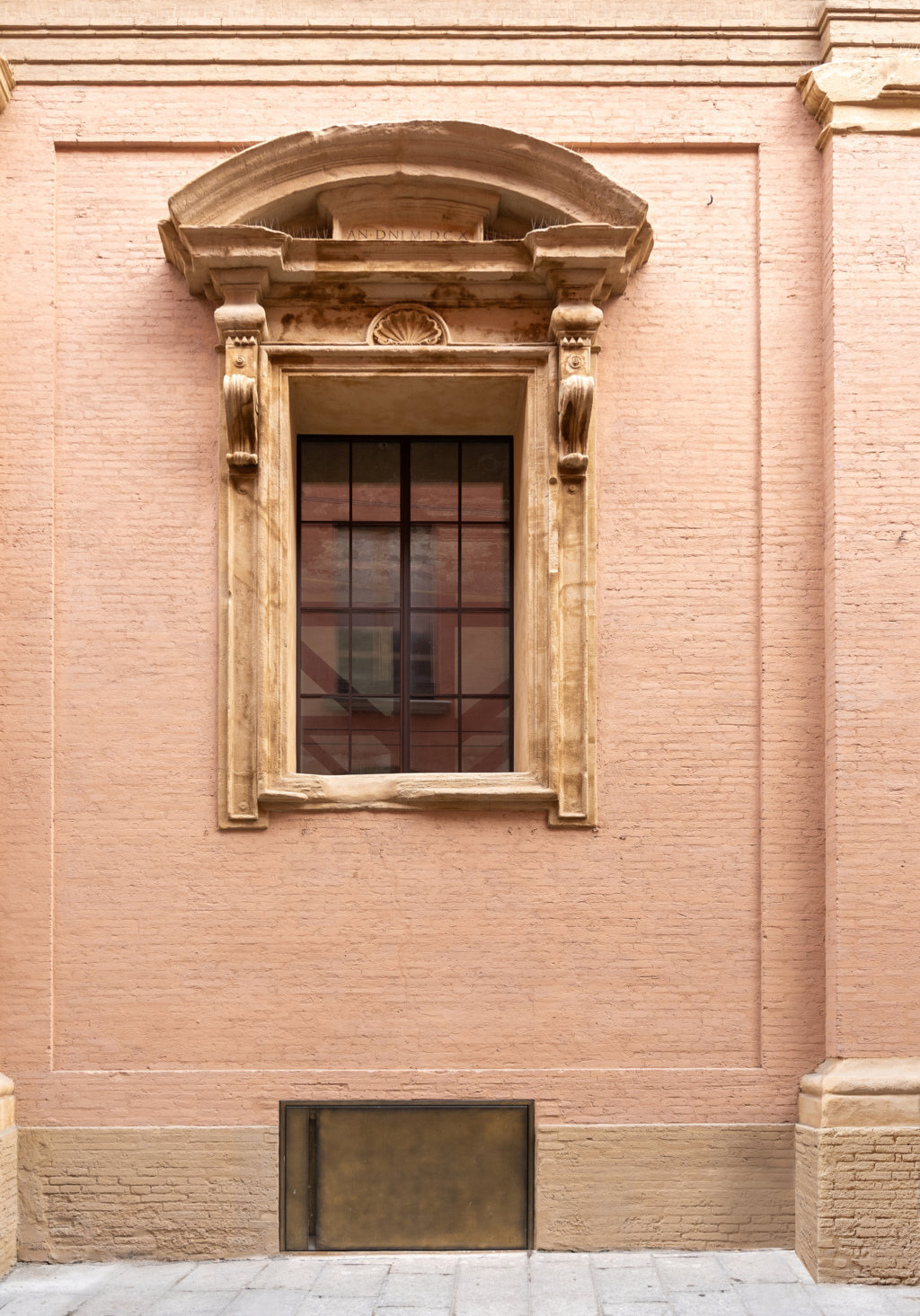
The architects’ answer is both restrained and assertive. The exterior has been treated with a conservationist’s care, cleaned, stabilized, and rendered legible without smoothing over the abrasions of time. The façade retains its unevenness, its chromatic variations, the sense of having endured rather than been completed. And yet, inserted within this fabric are a series of large, sharply defined openings, windows with minimal frames that appear as contemporary incisions. They do not imitate the original language of the church; instead, they allude to its more recent past, recalling the apertures of industrial buildings, the logic of storage and repair.
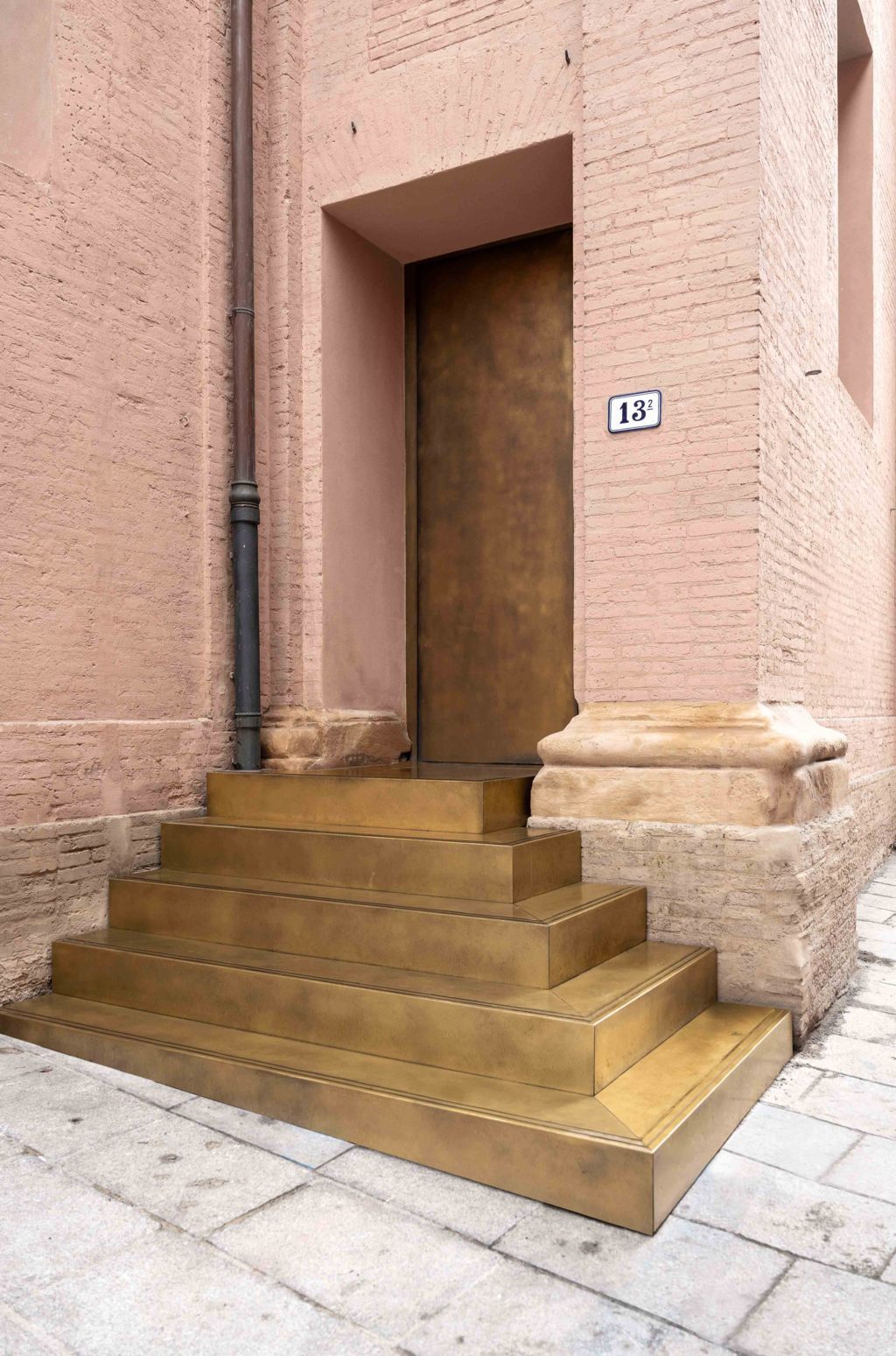
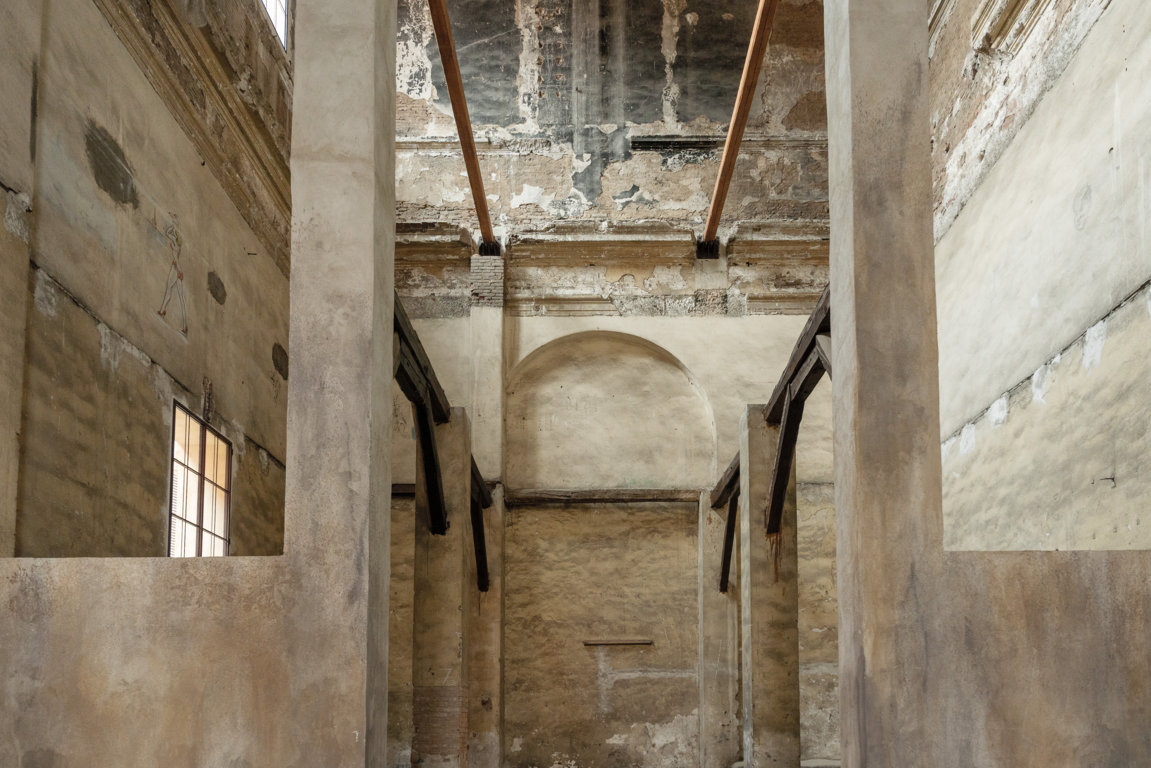
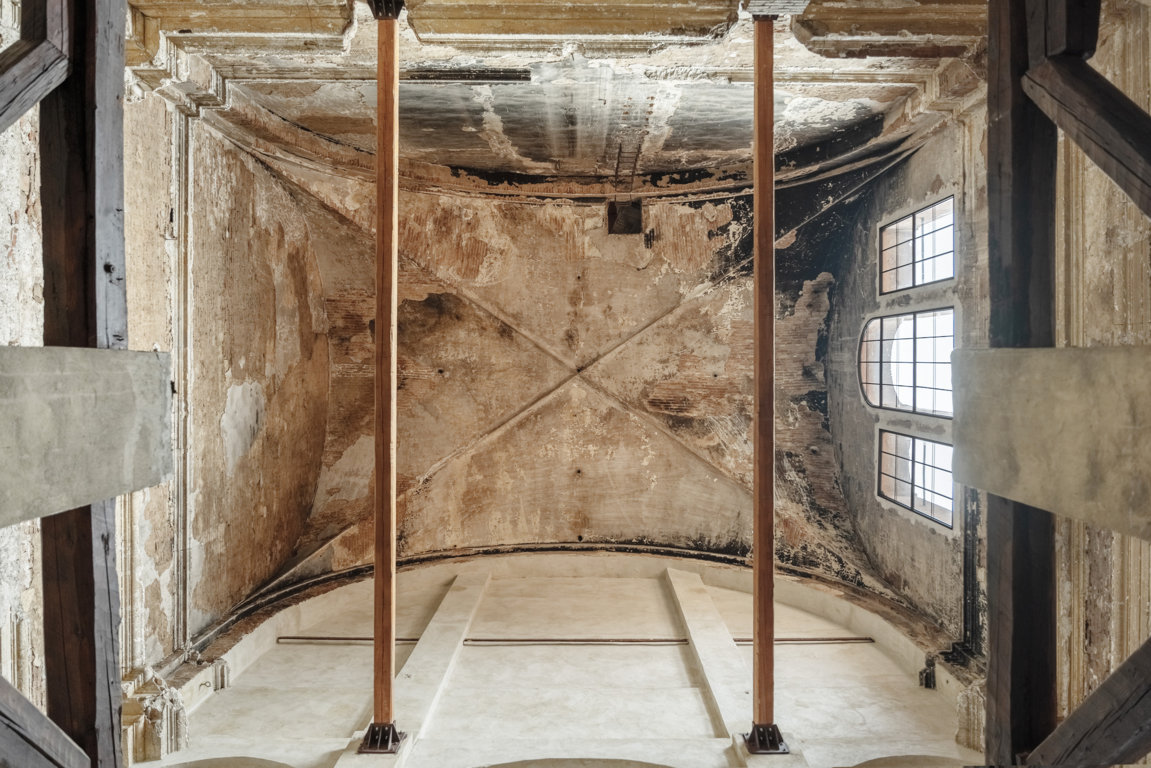
Rather than privileging the building’s sacred origin, the studio acknowledges the full continuum of its uses, treated not as aberrations but as layers, each one leaving a trace that deserves to remain legible. Materially, the intervention operates through calibrated contrasts. Corten and burnished brass, chosen as materials that register time through oxidation and patina, have been introduced as contemporary counterparts to the existing brick and sandstone. The Corten echoes the warm, earthen tones of the masonry, while the brass echoes the subtler hues of the stone elements. Neither attempts to disappear; both accept their inevitable transformation as part of the building’s ongoing narrative.
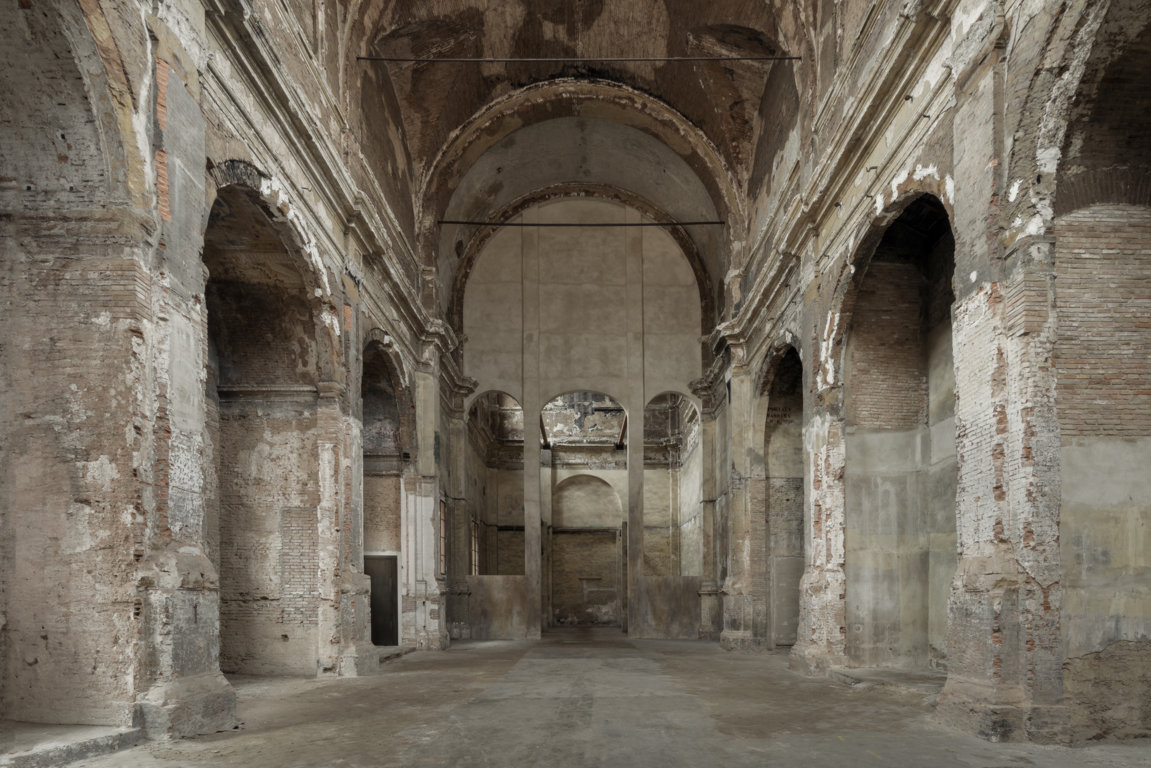
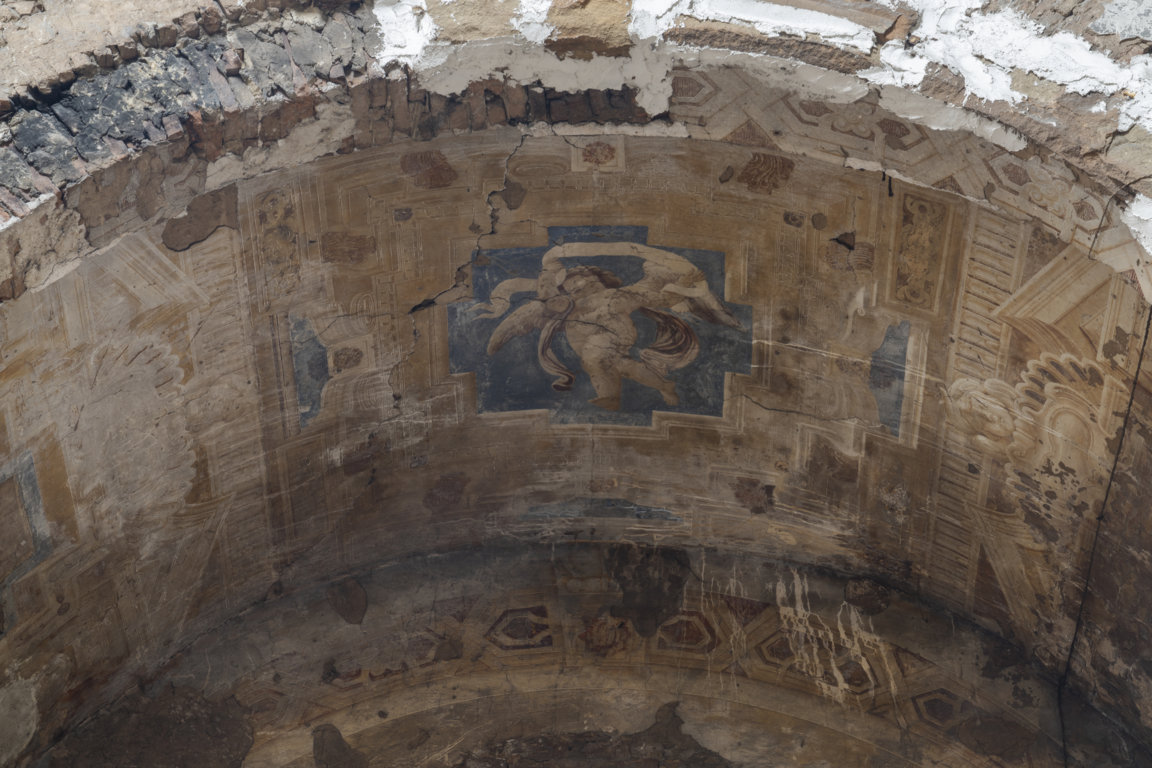
Inside, the effect is particularly atmospheric. The space, roughly 460 square meters, has been left largely intact, its surfaces consolidated but not reintegrated. Fresco fragments remain fragmentary; decorative schemes are suggested rather than restored. Light enters through the new openings and the large glazed portal, moving across walls that bear the marks of centuries: soot, abrasions, partial repainting, accidental inscriptions. The result is less an interior than a field of conditions, where perception shifts with the hour.
An almost curatorial sensibility is perceived. One is reminded, at moments, of an installation rather than a building, an environment in which disparate visual languages coexist without hierarchy. A patch of color on a pilaster recalls a painterly gesture; a stray graphic element, preserved on a vault, introduces an unexpectedly vernacular note. These fragments are not framed or explained. They simply persist, inviting the visitors to construct their own sequence of associations. Even the secondary entrance participates in this logic. Consisting of a monolithic brass portal, its steps seem to emerge from the ground as if extruded rather than assembled. A concealed line of light runs along the full height of the handle, producing a precise, almost surgical illumination that contrasts with the irregularity of the surrounding surfaces. It is a small but emblematic moment: the contemporary intervention does not compete with the ruin but rather seeks to sharpen it.
What Studio Poggioli has ultimately produced is not a restoration in the conventional sense, but a reframing. By refusing to reconstruct what is missing and by resisting the temptation to privilege a single historical moment, they allow the building to exist as a composite, a structure defined as much by loss as by presence. In doing so, they align themselves with a broader, if still relatively rare, architectural approach: one that sees value not in the recovery of an imaginary original, but in the acceptance of discontinuity.
In a city like Bologna, where history is often presented as a continuous surface, this approach feels almost radical. San Barbaziano does not offer a seamless narrative. It offers, instead, a series of interruptions, moments where time becomes visible, where the past refuses to settle into a single form. And in that refusal, the building finds a new kind of coherence: not as it was, but as it has always been.
This refined and fascinating dialogue between eras, told in such an authentic and charismatic way, has earned ‘Il progetto del tempo’ a place on the shortlist for the prestigious EUmies Awards 2026.
Credits
Photos: Alessandro Saletta – DSL Studio, courtesy of Studio Poggioli
Client: Musei Nazionali di Bologna – Direzione Regionale Musei Nazionali Emilia-Romagna
Project Manager (RUP): Arch. Denise Ottavia Tamborrino
Design Team: Studio Poggioli, Arch. Caterina Poggioli, Federico Poggioli