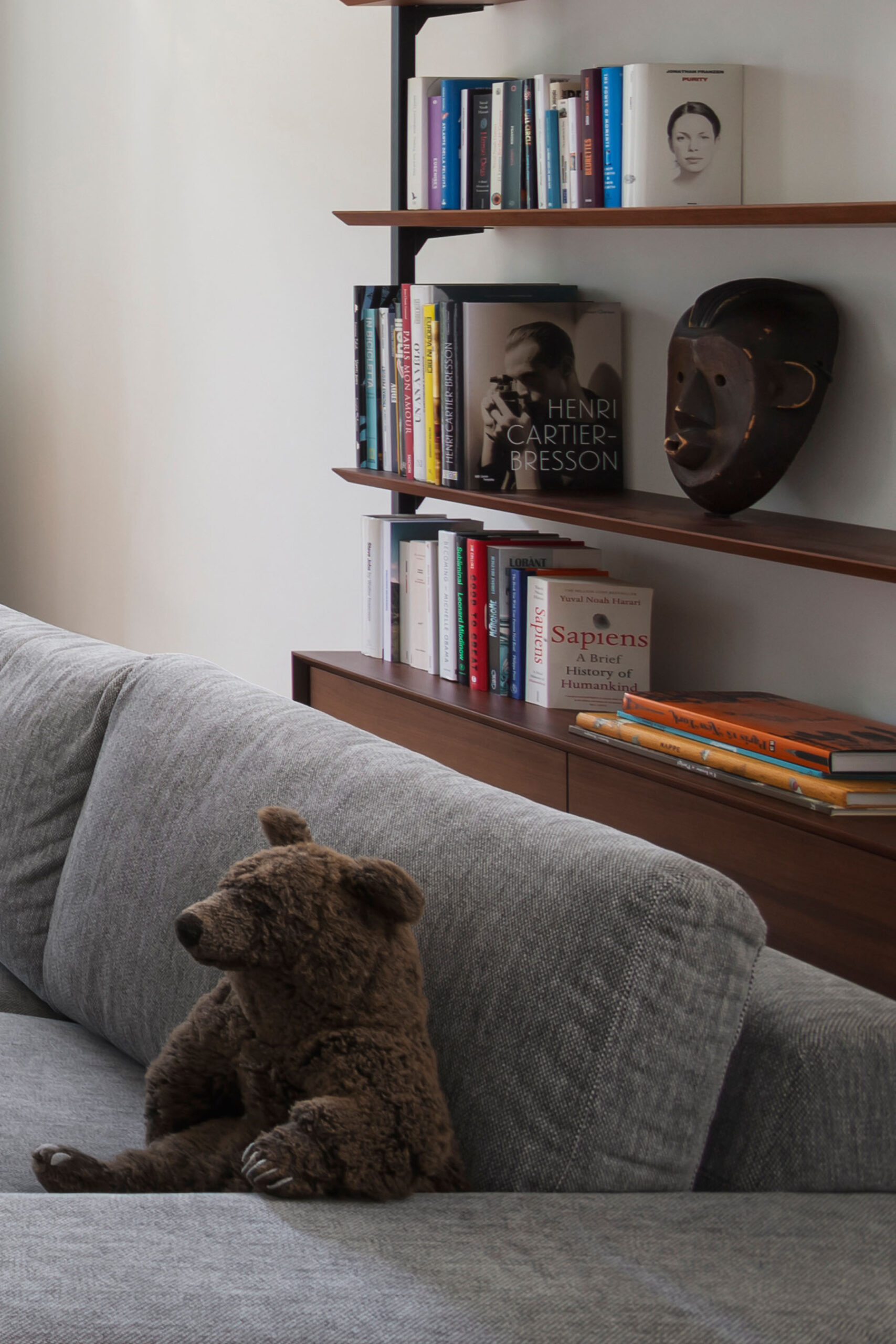


Architecture, like literature, can be interpreted as a narrative act: every space is a page, every detail a word. In this sense, the apartment Quoi l’éternité, designed by Studio Falù, emerges as an architectural rewriting. With a surface area of 160 square meters, this residence becomes a space of dialogue between past and present, where renovation is not merely a technical act but a cultural and poetic process.
The theoretical reflection accompanying this intervention is rooted in the awareness that the inhabitants of a house are both authors and protagonists of the spatial narrative. Architects, in this context, take on the role of mediators, guided by the memory of the place and the expressive power of materials.
Renovating a home with historical memory requires a careful analysis of the past, not to replicate it but to distill its essence. This process involves removing the superfluous, an act reminiscent of sculpture: liberating form from superstructures to reveal its core. As Jorge Oteiza suggests, the past and memory are not revealed in minute details but emerge through abstraction and contact with materials.
In the Quoi l’éternité apartment, the history of the place manifests itself in the choice to preserve and restore the original floors. The patina of the surfaces, the imperfections, and the texture of the materials are the true keepers of memory, connecting the home to its architectural and cultural heritage.
The relationship between history and material is expressed here in a silent yet powerful way. Renovated spaces, such as bathrooms and the kitchen, feature microcement surfaces—a material chosen for its visual homogeneity and its ability to serve as a neutral backdrop for historic surfaces. Microcement is not just functional but a narrative medium that bridges the ancient and the contemporary in a coherent dialogue.
The color palette further strengthens this narrative. The hues of the resins harmonize with the marble terrazzo flooring of the corridor, creating a complementary interplay with the exterior: terracotta echoes the green of the courtyard’s 19th-century palms, while blush tones complement the dark green of the evergreens visible from the children’s bedroom. This chromatic relationship not only unifies the interiors but also invites a connection with the exterior, integrating natural views into the spatial composition.
Every space in the home unveils a layered story, where past and new visions intertwine. Architecture becomes the medium through which these stories are expressed. The decision to preserve historical elements, like the floors, and to integrate contemporary materials, such as microcement, reflects a design approach that seeks not to dominate the past but to engage in dialogue with it.
Living spaces thus take on an active role in the narrative: the corridor, with its original flooring, becomes a timeline connecting the different areas of the home; the kitchen and bathrooms, with their modern surfaces, represent the present adapting to contemporary needs without severing ties with history.
As a reflection on the act of dwelling itself and the narrative dimension of architecture, Studio Falù’s project invites us to see domestic spaces as novels written collaboratively, where inhabitants and designers work together to create a unique story.
CREDITS
Project: Quoi l’éternité
Studio: studio Falù
Location: Milano, Italy
Year: 2022
Photo: Simone Furiosi